Governance
POLICYFORGEPolicy Automation
AI-assisted policy development and control gap analysis
Generate policies aligned to selected control baselines, evaluate existing policies for semantic coverage, identify gaps, and develop recommended language to address deficiencies. PolicyForge drafts the full governance set: the policy, the technical standard, the procedure and the compliance requirements. Reviewers approve every document, and the models that draft them run inside your boundary.
| Control | Verdict | Best match |
|---|---|---|
| AC-2 | Covered | Account Management Policy, 4.2 |
| AC-2(3) | Partial | Account Management Policy, 4.5 |
| AC-6(9) | Gap | No passage above threshold |
| AU-6 | Covered | Audit Procedures, 3.1 |
| CM-3 | Partial | Change Control SOP, 2 |
| IR-8 | Gap | No passage above threshold |
42 of 61 covered, 11 partial, 8 gaps
Illustrative run. Controls real, documents and scores invented.
Cross framework mapping
Working with multiple frameworks? Generate one doc-bundle that fits them all.
PolicyForge includes built-in cross-framework mappings for multiple compliance frameworks including NIST SP 800‑53, NIST CSF 2.0, and CMMC 2.0. Pick out your applicable frameworks when setting up your organization and create one set of documents. Still specific to your organization, each generated document now provides you the list of controls across other selected frameworks that are satisfied by each text section.

- The control baseline
- What your policies cover
Frameworks
We currently support the following frameworks. Can't find what you need? Reach out to the team to add your preferred frameworks to the list.
How it works
Profile, ingest, analyze, generate
01
Profile the organization
Name, mission, framework and impact level. Policies, documents and gap results are all stored against the profile, so one instance serves many organizations.
Illustrative profile. Everything invented.
02
Ingest what you have
Upload the existing policy set. Each document is chunked and embedded into a searchable corpus. A chunk that fails to embed is counted and reported, never silently scored as a gap.
0 chunks failed to embed. A failure is counted and reported, never scored as a gap.
03
Run gap analysis
Every required control is embedded and searched against your documents, so coverage written in different words still counts. Each control comes back covered, partial or gap with the passage it matched. Runs in the background, scoped to the controls you choose, and every run is kept with its history.
| Run | When | Scope | Covered / partial / gap |
|---|---|---|---|
| 3 | Today | 61 controls | 42 / 11 / 8 |
| 2 | 6 days ago | 61 controls | 39 / 13 / 9 |
| 1 | 3 weeks ago | 61 controls | 31 / 14 / 16 |
Every run kept, ten deep. Invented figures.
04
Generate and fix
Generate a policy against the baseline, prefilled from any gap you click. Or take a typed gap from evidence analysis in the ATO workflow and have the missing language drafted: one section per gap, a placement hint, bracketed parameters for your choices. Review, approve, export.
Account Management Policy, amendment
4.6 Privileged account review
Privileged accounts shall be reviewed every [review period] by the [reviewing role], and each review shall be recorded.
Place after 4.5 Periodic account review
Drafted from an evidence gap. Copy it, or save it to the library.
What it writes
Four documents per control set, not one
A policy alone does not pass an assessment. PolicyForge generates the full chain from what is required to how it is done to what proves it, each document numbered and exportable to DOCX or PDF.
Policy
The shall statements. What the organization requires, scoped to the controls and the impact level in the profile.
Technical standard
The specific settings, thresholds and configurations the policy demands, written so an engineer can implement them.
Procedure
Step by step operational instructions for the people who carry the policy out, in the order they do it.
Compliance requirements
The evidence artifacts required per control, so the ISSO knows what to collect before an assessor asks.
Generate one type or all four in a single run. Each lands in the library with its own review state and a document number.
Why it matters
The same control, two ways to get to a document
Where it connects
Built into the authorization, not beside it
ATO workflow
Policy and procedure gaps found during evidence analysis hand straight to PolicyForge with a Draft the missing language button. The draft lands in the library as an amendment drafted from evidence gaps.
AVISSAA
Evidence and technical gaps go the other way: AVISSAA says what artifact would close them.
The library
Generated policies, ingested documents and evidence driven amendments live together, filterable by type, each with a review state.
Review
Approve, hold in review or reject with notes. Nothing is published on a model's say so.
Six tabs
One workspace with the status, KPIs and recent documents up front, and a hand-off from every tab into Generate.
Seen in the app
The real thing, on synthetic data
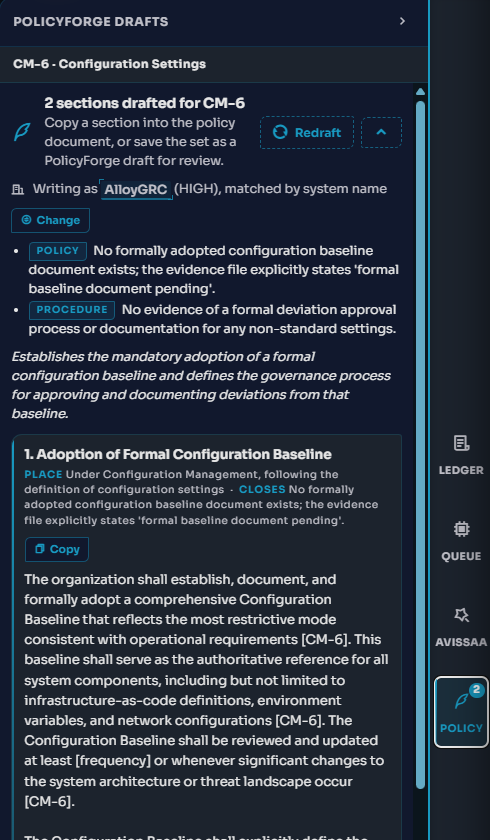
Drafted where the gap was found
Captured in the product on synthetic data.
How the draft gets there
Evidence is uploaded
An ISSO uploads a screenshot, a scan or a config export against a control, inside the ATO workflow.
A local model reads it
The evidence analyzer grades the artifact against the control and returns a verdict with its reasoning.
The gap is typed
Where the artifact does not satisfy the control, the shortfall is recorded as a typed gap, not a free text note.
PolicyForge drafts the close
A section per gap, with a placement hint and bracketed parameters. Copy it into the policy, or save the set as a draft.
What you can do
Set up an organization profile first, since policies, documents and gap results are stored against it
Generate the policy, the technical standard, the procedure and the compliance requirements for a control set in one run
Upload your existing policy set so gap analysis has a corpus to search
Run gap analysis to see each control scored as covered, partial or gap, with the matching passage
Read the matched passage before accepting a control as covered
Generate a policy from a gap, or draft the missing language from an evidence gap in the ATO workflow
Export a generated policy when you are ready to take it into review
Straight answers
What does it actually produce?
Four document types per control set: the policy statements, a technical standard with the settings the policy demands, a step by step procedure, and the compliance requirements listing the evidence each control needs. Any of them exports to DOCX or PDF.
How does it decide a control is covered?
It embeds the control statement, searches your document collection, and scores the best semantic match. High similarity reads as covered, middling as partial, low as a gap. Every result shows the text it matched so you can judge whether the match is legitimate.
Does it replace legal or leadership review?
No. It produces drafts and scored findings. A human still reviews and approves anything published, and the coverage scores are decision support rather than an assessment result.
Does it edit my existing policies?
No. A fix drafted from an evidence gap is a new section you copy or save as its own draft. The document you uploaded is never changed.
What frameworks does it cover?
NIST control content today, with additional frameworks as they are added.
Does my policy text leave the environment?
No. Drafting and matching run on models inside your own boundary.
Bring a policy. Leave with its gaps and the language that closes them.
Ask for a demo and we will run one of your documents, or a synthetic one, against a baseline in front of you.